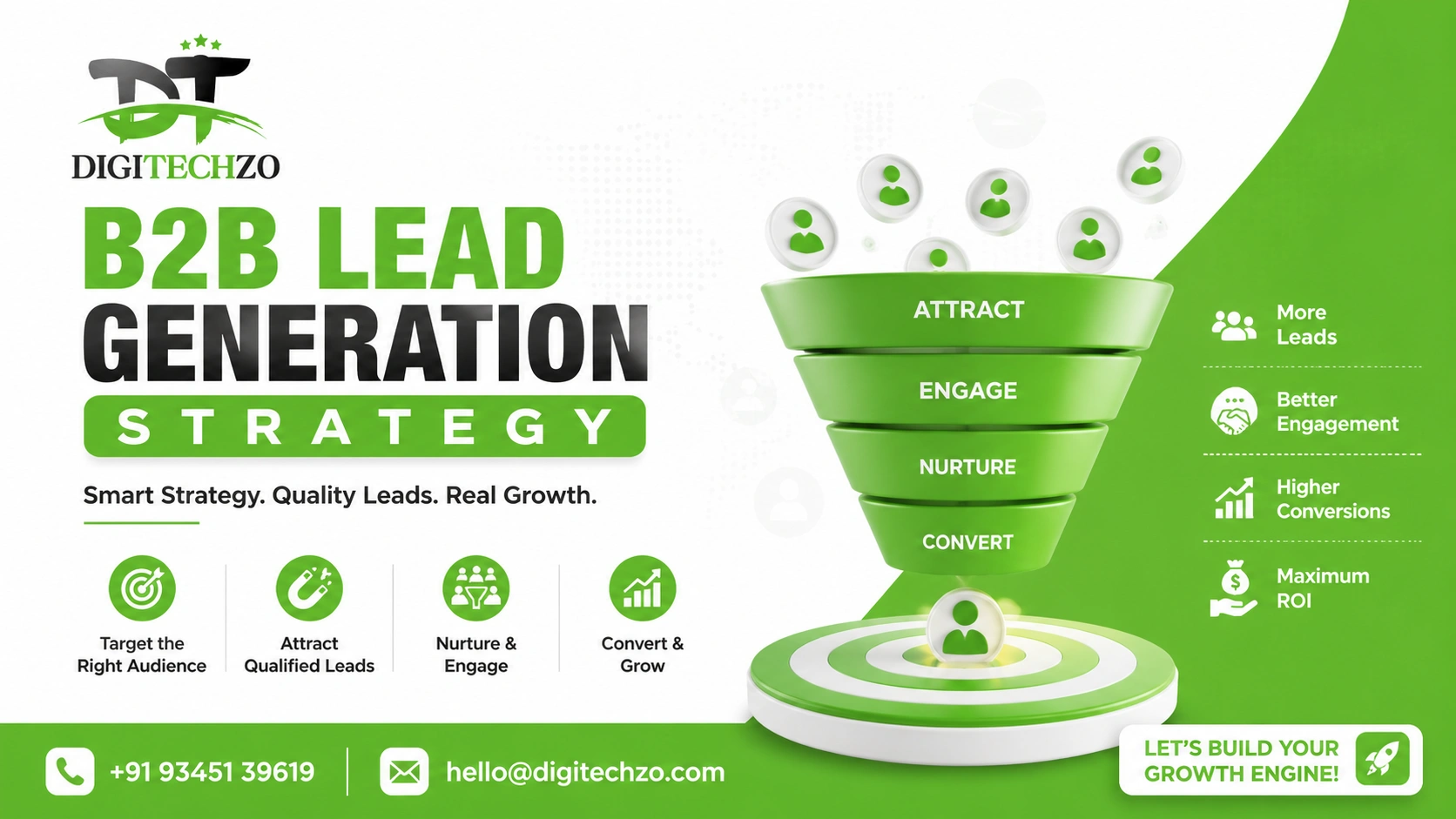
Most B2B companies aren't struggling to generate leads. They're struggling to generate leads that actually turn into revenue.
If you've ever watched a "500 new leads this month" report land in your inbox — only to see sales close three of them — you already know the problem. Volume isn't the bottleneck anymore. Marketing teams can buy lists, run ads, and fill a CRM in a weekend. What's hard is building a B2B lead generation strategy that consistently attracts buyers who are ready, qualified, and worth your sales team's time.
At Digitechzo, we've spent years inside this exact problem — auditing broken funnels, rebuilding lead scoring models, and helping B2B teams shift from "more leads" to "better leads." This guide distills that hands-on experience into a framework you can actually implement, not just another listicle of generic tactics.
A winning B2B lead generation strategy combines precise ICP targeting, multi-channel demand generation (SEO, LinkedIn, email, paid, referrals), and tight sales-marketing alignment on lead scoring and handoff. The goal isn't maximum leads — it's maximum qualified pipeline value per dollar spent. Companies that win treat lead gen as a system, not a campaign.
What B2B Lead Generation Actually Means in 2026
B2B lead generation is the process of identifying, attracting, and capturing information from businesses (not individual consumers) who show genuine buying intent for your product or service.
The catch: "showing interest" and "being sales-ready" are two very different things. A visitor who reads one blog post is not the same as a decision-maker who's compared three vendors and requested pricing.
A mature B2B lead generation strategy distinguishes between three lead types:
- Cold leads — fit your ideal customer profile (ICP) but haven't engaged
- Warm leads — engaged with content, downloaded resources, attended webinars
- Sales-ready leads — actively evaluating solutions, budget confirmed, timeline defined
Most companies pour budget into generating cold leads and wonder why conversion rates stay flat. The real strategy work happens in moving leads through these stages deliberately.
Why Most B2B Lead Gen Strategies Fail
In our work with B2B teams, the same failure patterns show up again and again:
- No defined ICP — marketing targets "anyone who might buy," diluting every channel
- Channel-hopping — abandoning SEO after 3 months because paid ads feel faster
- No lead scoring — sales gets flooded with unqualified leads and stops trusting marketing
- Content built for keywords, not buyers — ranking for traffic that never converts
- Weak follow-up systems — leads go cold because response time exceeds 24 hours
Research from Harvard Business Review has long shown that companies responding to leads within an hour are dramatically more likely to qualify them than those responding a day later. Speed and structure beat volume almost every time.
The Digitechzo Framework: Building a Lead Gen Strategy That Works
We use a four-stage framework with clients: Define → Attract → Convert → Qualify.
Define Your ICP and Buyer Personas
Before any channel work, nail down:
- Company size, industry, and revenue range
- Buying committee roles (economic buyer, technical evaluator, end user)
- Trigger events that create urgency (funding round, new hire, compliance deadline)
Example: A cybersecurity SaaS company we advised was targeting "any IT decision-maker." After narrowing to "Series B–D fintech companies undergoing SOC 2 audits," their lead-to-opportunity rate roughly doubled — because the messaging and content finally matched a specific, urgent pain point.
Attract with Multi-Channel Demand Generation
No single channel sustains B2B pipeline long-term. The strongest strategies layer:
- SEO-driven content (bottom-of-funnel and comparison pages)
- LinkedIn organic + targeted outbound
- Paid search for high-intent commercial keywords
- Webinars and gated resources
- Referral and partner programs
Convert with Intent-Matched Offers
Not every visitor wants a demo. Offer a ladder of engagement:
- Low commitment: guides, calculators, benchmark reports
- Mid commitment: webinars, templates, free audits
- High commitment: demo requests, consultations, pricing pages
Qualify Before You Route to Sales
This is the stage most companies skip. A structured qualification layer — using firmographic fit + engagement scoring — prevents your SDR team from wasting time on tire-kickers.
Top B2B Lead Generation Channels, Compared
| Channel | Best For | Time to Results | Cost Efficiency |
|---|---|---|---|
| SEO / Content | Long-term compounding pipeline | 4–9 months | High (long-term) |
| LinkedIn Outbound | Targeted enterprise accounts | 2–6 weeks | Medium |
| Paid Search (Google Ads) | High-intent, bottom-funnel capture | Immediate | Medium-Low |
| Webinars | Education-heavy, complex sales | 3–6 weeks | Medium |
| Referral/Partner | High trust, high close rate | Ongoing | Very High |
| Cold Email | Volume outbound testing | 1–4 weeks | Medium |
Pros and Cons Snapshot
SEO & Content
- Compounding, low cost-per-lead over time
- Slow to start, requires consistency
Paid Ads
- Fast, controllable, scalable
- Costs rise as competition increases; leads stop when spend stops
LinkedIn Outbound
- Direct access to decision-makers
- Requires strong personalization to avoid low response rates
Inbound vs Outbound: Which Should You Prioritize?
This is one of the most common questions we get — and the honest answer is: it depends on your sales cycle length and deal size.
- High-ticket, long sales cycle (enterprise SaaS, consulting): Prioritize outbound + ABM alongside SEO content that supports late-stage research.
- Mid-market, transactional products: Inbound (SEO + paid) tends to deliver better ROI at scale.
- New market entry / no brand recognition: Outbound builds initial pipeline while inbound assets mature in the background.
The best-performing companies don't choose one — they run both in parallel, using outbound to accelerate what inbound is building organically.
Lead Scoring and Qualification (MQL, SQL, PQL Explained)
- MQL (Marketing Qualified Lead): Engaged enough to signal interest (downloaded a guide, attended a webinar) but not yet vetted for fit or intent.
- SQL (Sales Qualified Lead): Vetted by sales or a qualification framework (e.g., BANT — Budget, Authority, Need, Timeline) as ready for direct outreach.
- PQL (Product Qualified Lead): Common in PLG models — a lead who has used the product (free trial, freemium tier) and shows usage patterns indicating buying intent.
A simple scoring model assigns points for both fit (industry, company size, role) and engagement (page visits, email opens, content downloads). Leads only route to sales once they cross a combined threshold — this single change often eliminates the "marketing sends junk leads" complaint entirely.
Common Mistakes in B2B Lead Generation
- Chasing lead volume over lead quality — a smaller list of well-matched prospects consistently outperforms a large, unfiltered one.
- No feedback loop between sales and marketing — if sales never reports back on lead quality, marketing keeps optimizing for the wrong signals.
- Gating everything — excessive gated content frustrates buyers early in their research and reduces total reach.
- Ignoring existing customers as a lead source — referrals and case studies from happy clients often convert faster than any paid channel.
- One-touch follow-up — most B2B buyers need 6–8 touches before engaging; a single email or call isn't a strategy.
- Tracking leads instead of revenue — vanity metrics (form fills) mean nothing if pipeline and closed revenue aren't tracked back to source.
Expert Tips to Improve Lead Quality Fast
- Build bottom-of-funnel comparison content. Pages like "[Your Category] vs [Competitor]" or "Best [Solution] for [Industry]" capture buyers actively comparing vendors — these convert far better than top-of-funnel blog traffic.
- Use intent data tools to identify companies researching relevant topics before they ever fill out a form.
- Shorten your lead capture forms. Every additional field reduces conversion rate; ask only what's essential to qualify, then enrich data on the backend.
- Respond within minutes, not hours. Set up instant notification and routing for high-intent form fills (demo requests, pricing inquiries).
- Repurpose sales calls into content. The exact objections and questions prospects raise on calls are your best source of new content topics.
- Align on a shared definition of "qualified." Sales and marketing should agree, in writing, on what makes a lead worth pursuing.
Why Choose DigiTechzo for Your B2B Lead Generation?
A high-performing B2B lead generation strategy is not about volume—it’s about building a consistent pipeline of qualified opportunities that convert into revenue. Without clear ICP alignment and tight coordination between marketing and sales, even multi-channel efforts fail to produce meaningful business outcomes.
Digitechzo approaches lead generation as a connected system rather than isolated campaigns. By aligning targeting, messaging, channel execution, and lead qualification with actual sales outcomes, the focus remains on maximizing pipeline value rather than just increasing lead count. This ensures that every activity—whether SEO, paid acquisition, or outbound—contributes to measurable growth and predictable deal flow.
For businesses looking to build a scalable and performance-driven pipeline, working with Digitechzo as a GTM AGENCY FOR B2B helps turn lead generation into a structured revenue engine rather than a series of disconnected efforts.
FAQs
What is the most effective B2B lead generation strategy?
There's no single "most effective" channel — the most effective strategy combines SEO-driven inbound content with targeted outbound (LinkedIn or email) and a clear lead scoring system, so quality is filtered before leads reach sales.
How long does B2B lead generation take to show results?
Paid channels can generate leads within days, while SEO and content-driven lead generation typically take 4–9 months to build meaningful, compounding traffic and conversions.
What's the difference between lead generation and demand generation?
Lead generation focuses on capturing contact information from interested prospects, while demand generation focuses on building broader awareness and interest in a category before a formal lead capture happens.
How many leads does a B2B company need per month?
It depends entirely on your average deal size and sales conversion rate — a company closing 20% of SQLs at a $50K average deal size needs far fewer leads than one with a $500 product and a 2% close rate. Work backward from your revenue target, not a generic lead quota.
Should small B2B companies focus on inbound or outbound first?
Early-stage companies with limited brand recognition often see faster results from outbound and paid channels, while investing in SEO content simultaneously so inbound pipeline matures over the following 6–12 months.