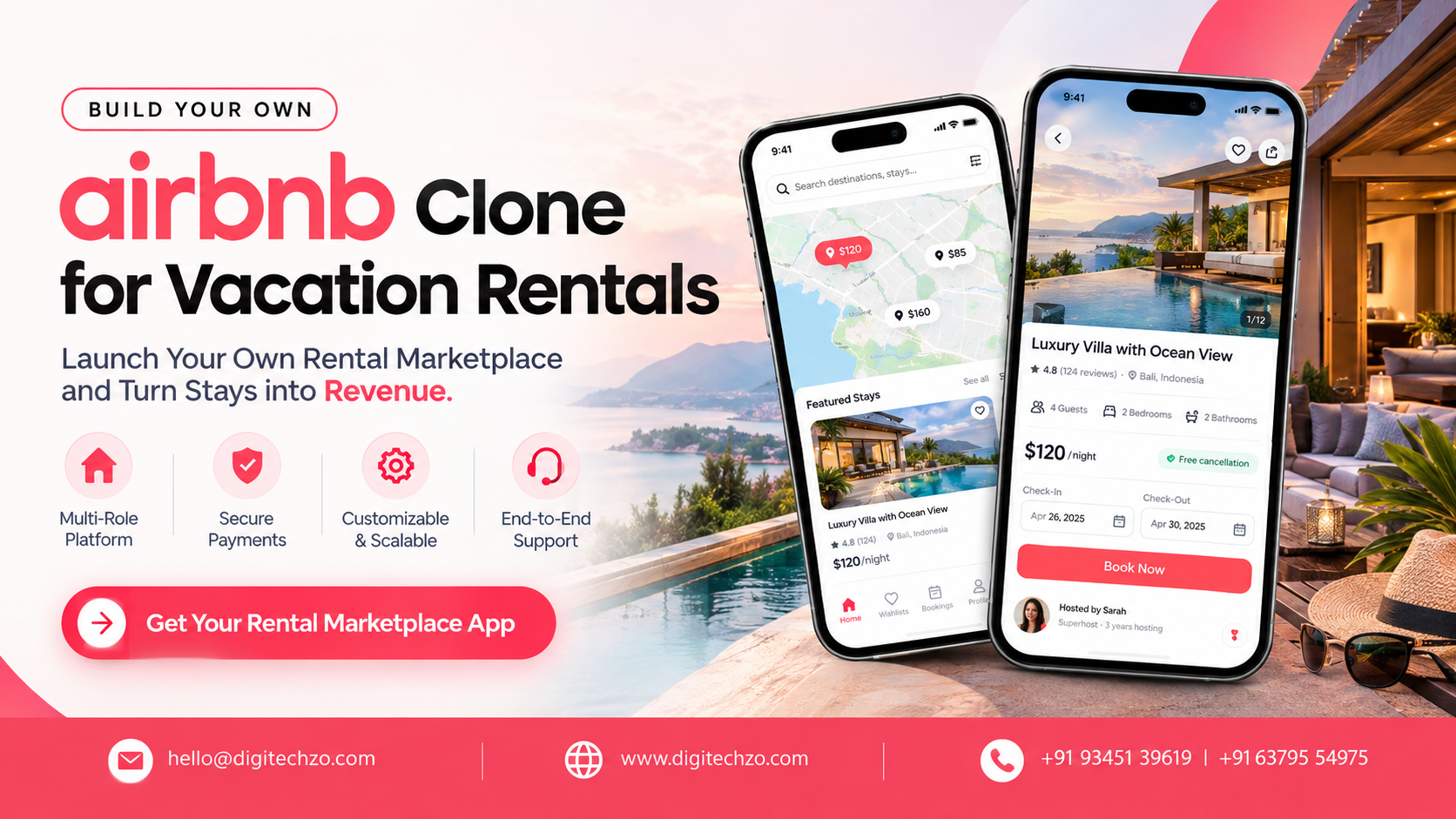
You have properties, relationships with owners or a niche in mind, such as villas, farm stays, long-stay apartments or glamping, and you want a platform where hosts list, guests book and you run the marketplace. You don't want to design calendars, payments, reviews and admin tools from scratch.
That's why an Airbnb clone is a common starting point. But the app is the easy part to describe. The real work lies in booking logic, trust, host supply and local rules. This guide walks through how the model works, what to build first, and what to verify before choosing a development partner.
An Airbnb clone is a ready-to-customize vacation rental marketplace foundation, typically a guest experience, a host experience and an admin dashboard, that you brand and adapt as your own platform. To choose and launch one well, define your niche and booking model, make sure the platform handles availability, payments and cancellations reliably, plan how you will attract hosts, and select a partner who is clear about customization, ownership and support. It should be an independently branded platform, not a copy of Airbnb.
What an Airbnb Clone Is (and Is Not)
"Airbnb clone" describes a platform that follows the two-sided rental marketplace model Airbnb made familiar: hosts list properties, guests search and book, and the platform handles payments and trust. Providers usually sell this as a white-label script or a custom-built solution.
A responsible project is:
A business-model-inspired platform with its own brand, interface, policies and positioning
A customized marketplace solution adapted to your region, property types, currencies and rules
Independently operated, with no suggestion of affiliation with Airbnb
It shouldn't copy Airbnb's trademarks, branding, interface designs, listing content or proprietary code. For legal questions, consult a qualified lawyer. This article is business and technical guidance, not legal advice.
How a Vacation Rental Marketplace Works
Guest Experience
Guests search by destination, dates, guest count, price and filters; browse listings with photos, amenities, house rules and reviews; message the host; book and pay; then review the stay.
Host Experience
Hosts create listings, upload photos, set prices and rules, manage an availability calendar, accept or decline requests, communicate with guests, track earnings and receive payouts.
Admin Dashboard
You approve or moderate listings, manage users, configure fees and commissions, handle cancellations, disputes and refunds, monitor payments, manage content and settings, and review analytics.
A typical booking flows like this: the guest searches and selects dates, the platform checks availability, the guest pays or sends a request, the host confirms (or the booking is instant), the stay happens, and the payout is released to the host after check-in under your payout rules.
Who Should Build a Rental Marketplace?
A rental marketplace suits you if:
You already have supply, such as managed properties, owner relationships or a local network
You target a niche that general platforms serve poorly
You want control over fees, branding and customer relationships
Think harder if your goal is simply to list your own few properties. A booking engine or direct-booking website may fit better than a full marketplace, because marketplace complexity (host onboarding, payouts, disputes) only pays off when you want third-party hosts.
Features That Matter Most
Guests
Registration and login, with identity verification options
Search by location, dates and guests, with filters (price, property type, amenities)
Map-based discovery and wishlists
Detailed listings with photos, rules, cancellation policy and reviews
Booking, secure payments and messaging
Booking history, receipts and reviews
Hosts
Listing creation with photos, amenities, rules and pricing
Availability calendar with blocked dates and minimum stays
Seasonal pricing, discounts and cleaning or extra-guest fees
Booking management and messaging
Earnings dashboard and payout settings
Admin
Listing approval and moderation
Fee, commission and tax configuration
Cancellation, refund and dispute handling
User and host verification management
Content, location and amenity management
Reports on bookings, revenue and host activity
Add advanced features, such as AI-assisted listing descriptions, smart pricing suggestions, subscription plans, multi-language and multi-currency support, after the core booking flow is solid.
The Booking Logic That Makes or Breaks the Platform
Most guides list features and skip this. Rental platforms live or die on a few rules.
Double bookings, unclear cancellation rules and payout confusion damage host trust quickly. Ask any provider how the platform handles each of these, and ask to see them work.
Business Models and Revenue Streams
Possible models include:
Guest service fee added to the booking
Host commission deducted from earnings
Listing or subscription fees for hosts or agencies
Featured or promoted listings
Add-on services such as cleaning, insurance referrals or experiences, where you can support them
Premium plans for professional hosts or property managers
None guarantees profitability. Revenue depends on bookings, supply quality, competition and costs such as payment processing, support and marketing.
Solving the Host Supply Problem
Guests only come when there are good listings, and hosts only list when guests come. A practical approach:
- Pick a niche or location where you can offer something general platforms don't: curated villas, long stays, pet-friendly stays, corporate housing, rural retreats
- Onboard hosts personally at first, ideally those you already know
- Make listings excellent with strong photos, accurate descriptions and complete amenity data
- Make hosting easy, especially calendar and pricing tools
- Offer a clear value to hosts, such as lower fees, better support or access to a specific audience
- Grow by region once bookings and reviews build trust
Ready-to-Customize Foundation vs Custom Development
Be careful with claims like "launch in days" or "half the cost." They depend on what's included, how much you customize and which integrations you need.
Technology and Integrations to Plan For
Payment gateways: cards, wallets and local methods, plus split payments or host payouts. Check what's supported in your country.
Maps and location search: for map views, geocoding and nearby search
Calendar sync: standard calendar formats and, if needed, integrations with channel managers or property management systems
Messaging and notifications: email, push and SMS
Identity and document verification, where your market expects it
Image storage and delivery, since listings are photo-heavy
Search infrastructure: fast filtering over many listings
Cloud hosting, monitoring, backups and security
Web and mobile apps, depending on your audience
Third-party services have usage costs that add to your running budget.
What the Platform Does Not Solve
Hosts and guests: supply and demand still need to be built
Regulation: short-term rental rules, licensing, taxes and registration requirements vary by city and country, and may affect how you operate
Trust and safety: verification, damage and dispute policies, and handling incidents
Customer support: guests and hosts need people to resolve problems
Insurance and liability: consider what protection your platform and hosts need, with professional advice
Marketing and SEO: attracting travellers is an ongoing effort
What to Look for in a Clone Development Partner
Working demo: can you see guest, host and admin flows including booking, payment and cancellation?
Booking logic: how are double bookings prevented, and how does calendar sync work?
Payments: are deposits, split payouts and refunds supported for your region?
Customization scope: what can be changed (branding, listing fields, fee structure, workflows) and what cannot?
Search and performance: how does it perform with many listings and images?
Integrations: which payment, maps, messaging and calendar integrations are supported?
Ownership: do you receive the source code, under what licence, and who owns your customizations?
Security and testing: how are user data and payments protected, and how is the product tested?
Scalability: how does it handle more listings, bookings and regions?
Support: what is included after launch, and for how long?
Candor: does the provider explain limits, or only benefits?
Common Mistakes to Avoid
- Building a marketplace when a booking website would do
- Ignoring host supply until after launch
- Skipping the booking-logic details (double bookings, cancellations, payouts)
- Launching in too many places at once
- Copying Airbnb's branding, design or listing content
- Overlooking local short-term rental regulation
- Not clarifying source-code and ownership terms
- Underestimating support and trust-and-safety workload
Why Choose DigiTechzo for Rental Marketplace Development?
A rental marketplace combines several moving parts: guest and host experiences, booking and payment logic, integrations and an admin system. Your development partner affects how well these work together and how easily the platform can grow.
DigiTechzo describes itself as a business growth technology company, with services across AI development, websites, mobile apps, blockchain, software and growth marketing. For a rental marketplace project, that means you can discuss the web and mobile experiences, admin tooling and integrations with a team that works across product development and business growth, and shape the platform around your own brand, niche and operating model.
FAQ
What is an Airbnb clone?
It is a ready-to-customize vacation rental marketplace, usually with guest and host experiences and an admin dashboard, that follows the familiar two-sided rental model under your own brand.
How does a vacation rental marketplace work?
Hosts list properties and manage availability, guests search and book, the platform processes payment and applies fees, and the host is paid under your payout rules after the stay begins.
What features does a rental marketplace need at launch?
Search and filters, detailed listings, an availability calendar, booking, payments and payouts, messaging, reviews, and admin tools for moderation, fees and disputes.
Should bookings be instant or request-based?
Instant booking is smoother for guests, while request-to-book gives hosts more control. Many platforms offer both.
How do rental marketplaces make money?
Common models are guest service fees, host commissions, subscriptions, featured listings and add-on services. Profitability is not guaranteed.
Should I use a ready-made foundation or build custom?
A ready foundation suits standard rental workflows and quicker validation. Custom development suits unusual booking logic, deep integrations or proprietary technology.
How do I prevent double bookings?
Through a reliable availability system and calendar sync with any external calendars hosts use. Ask providers how they handle this.