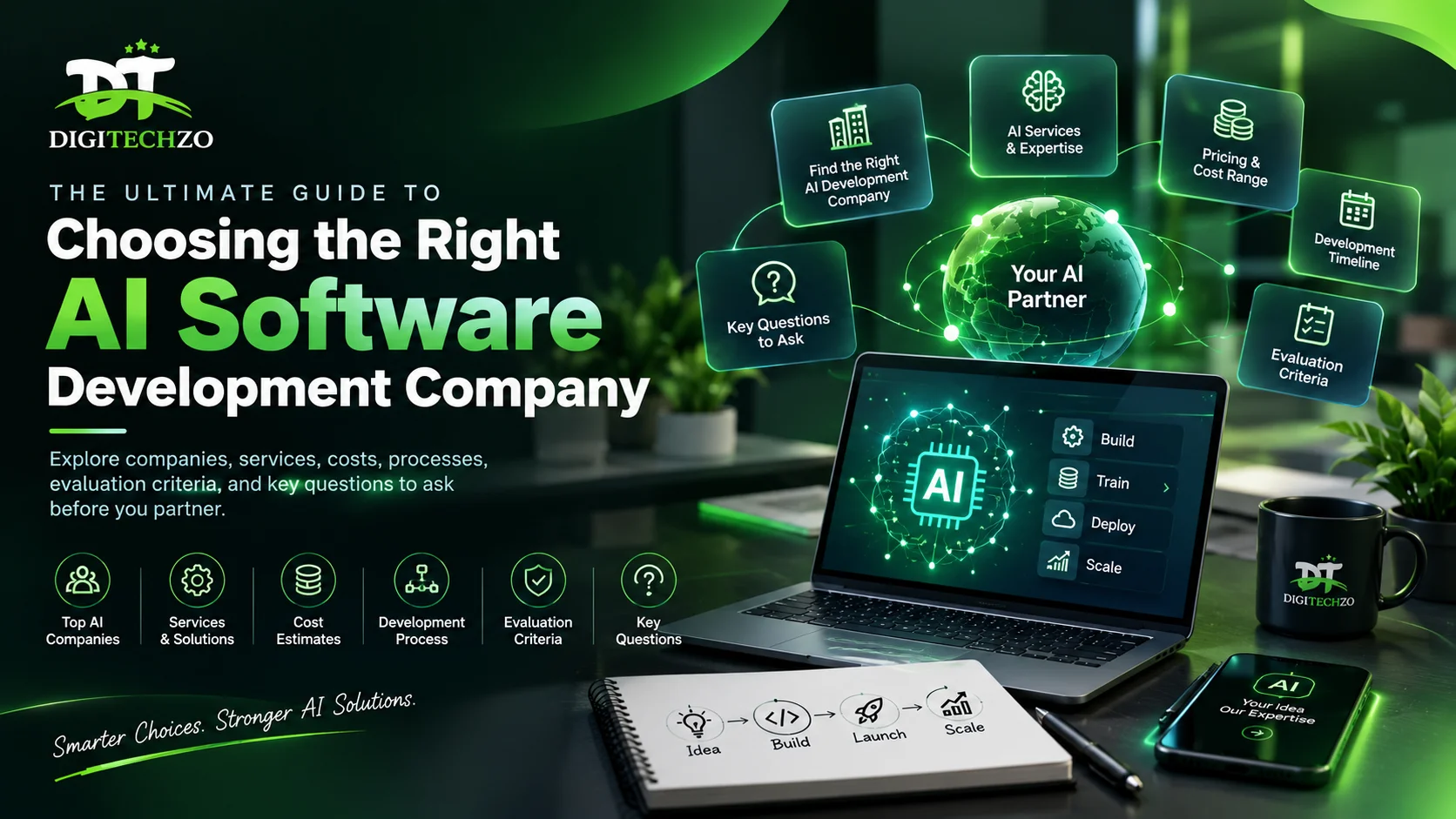
Most AI projects don't fail because the technology doesn't work. They fail because the wrong partner was chosen to build it - one that could demo a model but couldn't get it into production, own its accuracy over time, or explain who holds the IP when the engagement ends. Picking an AI software development company is a different decision from picking a general software vendor, and treating it the same way is where most of the budget gets wasted.
This guide breaks the decision down into what actually matters: what these companies do differently from a generic dev shop, how to score a shortlist objectively, what the work really costs in 2027, and which questions expose a vendor before you've signed anything. It reflects the same evaluation lens teams like DigiTechzo apply internally when scoping a new AI engagement, not a marketing pitch dressed up as advice.
An AI software development company designs, builds, and deploys custom artificial intelligence systems - machine learning models, generative AI applications, and automation pipelines - tailored to a specific business problem, rather than selling a pre-built AI product. The right partner is chosen not by who has the flashiest demo, but by technical depth, relevant industry experience, transparent pricing, and a clear plan for who owns and maintains the system after launch.
What an AI Software Development Company Actually Does
The term gets used loosely. Three categories get lumped together, and confusing them is the single most common reason companies pick the wrong partner.
AI SaaS platforms
sell a pre-built product - a customer service bot, a forecasting tool, an analytics dashboard - that you configure but don't own. You're renting capability, and you're constrained by the vendor's roadmap.
Integrators
connect existing AI models (typically an LLM API from OpenAI, Anthropic, or Google) to your existing software using off-the-shelf tooling. This is fast and often the right call for well-defined use cases like a support chatbot or document summarizer, but it usually stops short of custom model training, deep MLOps, or ownership of the underlying system.
AI software development companies
build custom systems from your data and your requirements: fine-tuned or custom-trained models, retrieval-augmented generation (RAG) pipelines built on your proprietary knowledge base, MLOps infrastructure for retraining and monitoring, and integration into your existing architecture. You walk away owning the codebase and the model, not renting access to someone else's.
None of these is inherently "better." The right choice depends on your use case - which is exactly what the next section works through.
What You Should Actually Own at the End of an Engagement
If a vendor's deliverable stops at a working demo, that's a signal you're looking at a prototype shop rather than a production partner. A real AI software development engagement should hand you:
- A data-readiness assessment showing what your data can and can't currently support
- An owned model or codebase - not a black box you can't inspect, retrain, or move
- CI/CD pipelines for retraining as data and requirements change
- Monitoring for model drift, latency, and cost, not just a one-time accuracy score
Build vs. Integrate vs. Buy: Choosing the Right Approach First
Before evaluating vendors, get clear on what you're actually asking them to do. This decision changes everything downstream - timeline, cost, and which companies even belong on your shortlist.
| Approach | Best When | Typical Cost Range | Ownership |
|---|---|---|---|
| Buy (AI SaaS) | The use case is generic and well-served by existing tools | $1,000-$50,000 lifetime | Vendor owns the platform; you rent access |
| Integrate | You need an LLM-powered feature added to existing software fast | $10,000-$100,000+ | Shared - you own the integration, not the model |
| Custom build | Your data, workflow, or compliance requirements are specific | $50,000-$500,000+ | You own the model, codebase, and pipeline |
A useful gut check: if you can describe your AI need in one sentence that matches a category of existing product ("we need a support chatbot"), you probably don't need full custom development - an integrator or SaaS tool will get you there faster and cheaper. If your requirement involves proprietary data, a workflow no off-the-shelf tool handles, or regulatory constraints that rule out third-party black boxes, custom development is usually the only path that holds up.
Criteria for Evaluating an AI Software Development Company
Once you know what kind of engagement you need, evaluate vendors against the same six or seven criteria - informally, or with a weighted scorecard if you're comparing more than two or three finalists.
1. Technical Depth Beyond API Wrapping
There's a meaningful difference between a team that calls a foundation model's API and one with in-house data scientists who can fine-tune, evaluate, and optimize models against your specific metrics. Ask what frameworks they actually work in - PyTorch, TensorFlow, and modern LLM tooling (LangChain, LlamaIndex, vector databases) are reasonable baseline signals - and ask them to walk through a technical decision they made on a past project, not just show you the outcome.
2. Industry and Domain Experience
A model that's technically sound but doesn't reduce churn, speed up a specific workflow, or cut real operational cost isn't a win - it's a sunk cost. Case studies from your industry (or a genuinely comparable one) matter more than a long client logo list, because domain context shapes almost every technical decision an AI team makes.
3. Quality of the Discovery Process
Vendors who propose a technical approach before understanding your business problem are optimizing for closing the deal, not for your outcome. A strong discovery process includes a data-readiness assessment, clear success metrics defined before any code is written, and honesty about what's achievable given your current data - including telling you when a project isn't ready to start.
4. Data Handling, Security, and IP Ownership
Clarify, in writing, before signing: who owns the trained model and the code, what happens to your data during and after the engagement, and what compliance standards apply (SOC 2, HIPAA, GDPR, or industry-specific frameworks). This is the single most commonly skipped step in vendor evaluation, and the one that causes the most expensive disputes later.
5. Evaluation Discipline
Ask whether the team runs offline evaluations, A/B testing, hallucination tracking, or defined latency and cost targets - or whether "it works" is based on a handful of manual checks. Teams with real production experience treat evaluation as an ongoing discipline, not a one-time gate before launch.
6. Pricing Transparency
Vague, all-inclusive quotes are a red flag. A credible AI development company can break down cost by phase (discovery, proof of concept, build, deployment, ongoing MLOps) and explain what drives cost up or down.
7. Post-Launch Support Model
AI systems aren't "done" at launch the way a typical software feature is. Model performance drifts as real-world data shifts, and someone needs to own retraining, monitoring, and incident response. Ask explicitly what happens in month three, six, and twelve - and get the answer in the contract, not just the sales conversation.
How Much Does AI Software Development Cost in 2027?
Cost estimates vary widely because "AI development" spans everything from a $10,000 chatbot integration to a $500,000+ custom enterprise system.
Hourly Rates by Region and Seniority
| Region | Junior/Mid-Level | Senior/Specialist |
|---|---|---|
| United States / Canada | $80-$150/hr | $150-$300/hr |
| Western Europe | $70-$130/hr | $130-$220/hr |
| Eastern Europe | $35-$80/hr | $60-$150/hr |
| India / South Asia | $20-$50/hr | $40-$100/hr |
Specialist roles command a premium regardless of region: LLM/generative AI specialists and MLOps engineers typically bill 20-40% above general AI developer rates given how scarce that experience still .
Typical Cost by Project Scope
- Off-the-shelf integration (chatbot on an existing LLM, basic automation): roughly $10,000-$50,000
- Mid-complexity custom build (RAG system, workflow-specific ML model): roughly $50,000-$150,000
- Enterprise-grade custom AI system (proprietary model training, full MLOps, compliance-heavy deployment): $150,000-$500,000+
Infrastructure is a separate line item worth budgeting for early. GPU compute for training/fine-tuning can run $2-$100+ per hour depending on scale, and ongoing monitoring/retraining/data-pipeline costs typically land between $20,000-$50,000+ per year - a cost many first-time buyers don't budget for because it's absent from the initial quote.
What the AI Development Process Actually Looks Like
- Discovery and data assessment - defining the problem, success metrics, and whether current data can actually support the intended model.
- Proof of concept - a scoped, time-boxed build that validates the technical approach before full investment.
- MVP build - the first production-ready version, covering the core use case.
- Deployment and integration - connecting the system into existing infrastructure, with defined rollback/testing plans.
- Monitoring and retraining - the ongoing phase where most long-term value (and cost) actually sits.
Vendors who skip straight from "discovery call" to "full build proposal" without a proof-of-concept step are asking you to commit budget before either side has validated the approach.
Red Flags to Watch For
- The proposal recommends a technical solution before any discovery or data review has happened
- Pricing is a single lump sum with no breakdown by phase
- The team can't name specific frameworks or tools, only that they "use AI"
- No mention of model ownership, IP, or what happens to your data
- Case studies show project names and logos but no measurable outcomes
- No plan offered for what happens after launch
Questions to Ask Before You Sign
- What have you delivered in our industry, with what measurable outcome?
- Who owns the trained model, the code, and the data pipeline once the engagement ends?
- What does your evaluation process look like - how do you know the model is actually working?
- What's included in post-launch support, and what triggers additional cost?
- How do you handle changing requirements or a blocked data source mid-project?
- What compliance certifications or practices apply to how you handle our data?
Why DigiTechzo Is the Right AI Software Development Partner
Choosing an AI Development Company ultimately comes down to whether their approach matches how you actually plan to use the system - not just whether they can build something that works in a demo. DigiTechzo's approach to AI development is built around the criteria above, because they're the ones that determine whether a project survives past launch.
- Discovery before architecture. Every engagement starts with an honest data-readiness assessment, including telling clients when a use case isn't ready for a full build yet - before budget is committed, not after.
- Ownership, not lock-in. Clients leave with the trained model, the codebase, and the pipelines - not a dependency on DigiTechzo to keep the system running.
- Full-cycle capability. DigiTechzo works across custom AI model development, LLM and RAG integration, and the MLOps infrastructure needed to keep a system accurate after deployment.
- Transparent scoping. Pricing is broken down by phase, so you know what's driving cost before work begins.
If you're weighing whether to build custom, integrate an existing model, or evaluate a shortlist of AI Development Company against your own criteria, that's a conversation worth having before any contract is on the table - DigiTechzo's team is available to walk through where your specific use case actually fits.
Frequently Asked Questions
What's the difference between an AI software development company and an AI consulting firm?
Consulting firms typically advise on AI strategy and vendor selection without building the system themselves. An AI software development company designs, codes, and deploys the actual solution.
How long does a typical AI development project take?
A proof of concept usually takes 4-8 weeks. A mid-complexity custom build typically runs 3-6 months, with enterprise-grade systems often taking 6-12 months.
Should I choose a company that builds custom models or one that integrates existing LLMs like GPT or Claude?
It depends on your data and use case. Well-served-by-existing-capability use cases favor integration; proprietary-data-dependent value favors custom development.
Do I need an in-house AI team if I hire a development company?
Not necessarily at the start, but plan for at least one internal owner who can manage the vendor relationship and retraining priorities over time.