Most AI products don't fail because the underlying model is weak. They fail because a team skips validation, underestimates what it costs to run AI in production, or mistakes a working demo for a finished product. If you're evaluating AI product development services in 2026, that gap - between something that works in a demo and something that works reliably for paying users - is the single biggest risk to your budget and your timeline.
This guide walks through the full AI software product development process, from validating an idea through building, launching, and scaling it - including realistic cost ranges, the failure patterns specific to AI projects, and what separates a production-ready AI product development solution from a prototype. At DigiTechzo, this is the process we use as an AI product development company scoping and delivering work for founders and enterprise teams - so the framework below reflects how real AI product development services are run, not just theory.
What Is AI Product Development?
AI product development is the discipline of designing, building, and shipping a product whose core value depends on artificial intelligence - machine learning, natural language processing, computer vision, or a generative AI model - rather than on AI being a bolted-on feature. It spans everything from the initial problem definition to the infrastructure that keeps the product accurate, fast, and cost-efficient once real users depend on it.
The distinction that matters most: traditional software behaves the same way every time it runs a given input. AI products are probabilistic. The same input can produce a slightly different output, model behavior drifts as real-world data changes, and quality has to be measured continuously rather than verified once during QA. That's why AI software product development needs its own process, its own cost model, and its own way of evaluating whether something is actually ready to launch - and why founders increasingly look for AI product development solutions built specifically around that difference, rather than a traditional dev shop bolting AI onto a standard software process.
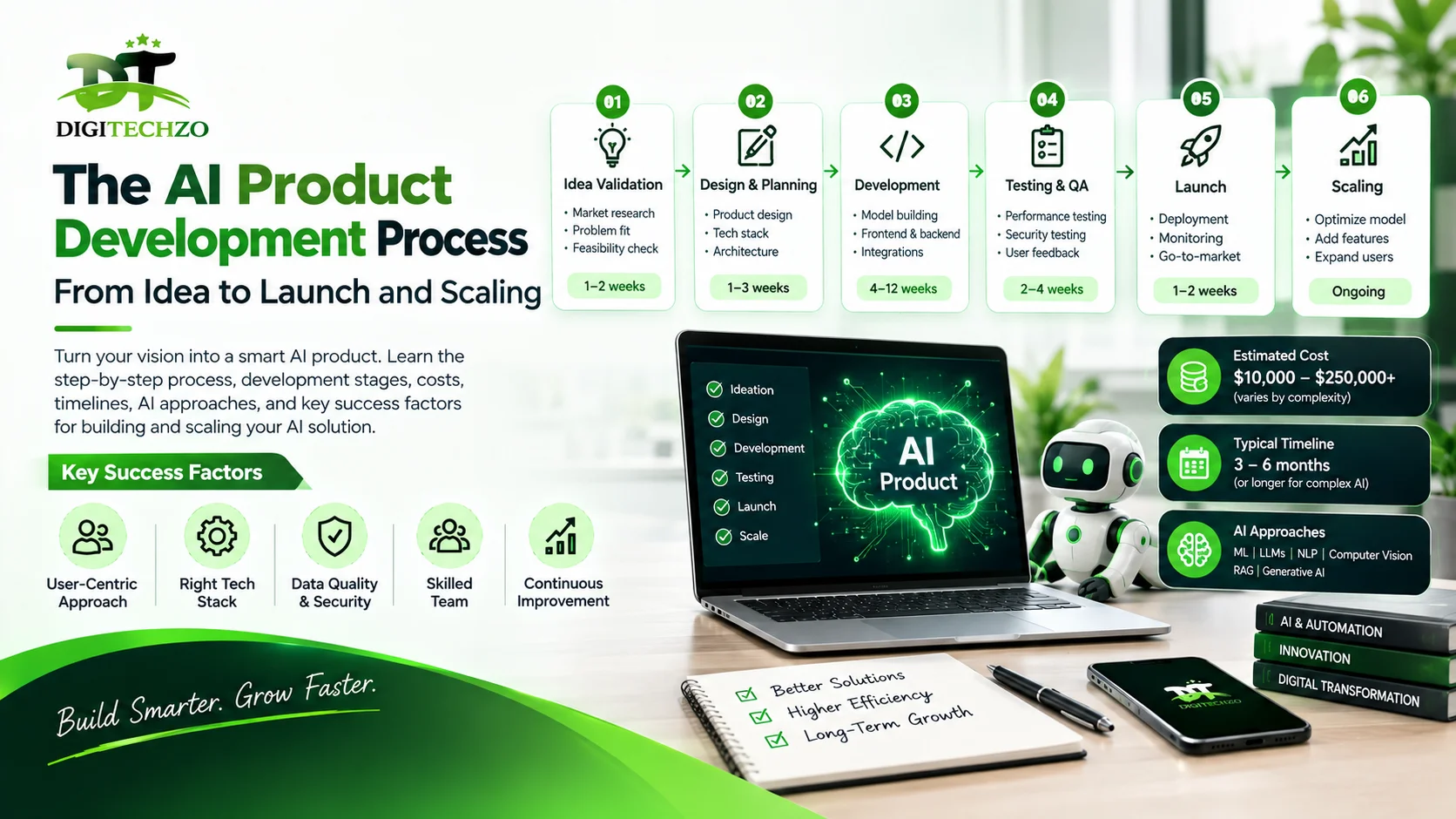
The AI Product Development Process: 7 Stages From Idea to Launch
Most well-run AI products move through seven stages. Skipping or rushing the first two - problem definition and data discovery - is the single biggest driver of costly rework later, since teams that build first and validate later routinely stall in production hardening.
Stage 1 - Problem Definition & Business Case Validation
Before any development starts, define the exact problem, the specific customer segment, and the workflow the AI is meant to improve. Validate demand cheaply - a landing page, structured interviews, or a manual (non-AI) version of the workflow - before committing engineering budget. The test to pass here is simple: can you confirm that people urgently want this solved, not just that it would be nice to have?
Stage 2 - Data Discovery & Assessment
AI products live or die on data. This stage honestly assesses what data you have, what quality it's in, whether you're legally allowed to use it, and what's missing. If there's no usable data and no credible plan to get it, there's no real AI advantage yet.
Stage 3 - AI Approach Selection & Architecture
Decide the technical approach: a hosted foundation model API (Claude, GPT, Gemini, and similar), a retrieval-augmented generation (RAG) system grounded in your own data, a fine-tuned model, or in rarer cases a custom-trained model. Most AI software product development projects in 2026 start with foundation model APIs and RAG rather than training anything from scratch.
Stage 4 - Prototype & Proof of Concept
A prototype proves technical feasibility, not product-market fit. It answers "can this be built at acceptable quality and cost?" using a small, realistic slice of the problem. Keeping "we built it" and "we rigorously evaluated it" as two separate, honest claims here prevents a common trap: a prototype that looks finished getting greenlit for full production before anyone has tested it against real edge cases.
Stage 5 - MVP Development & Testing
This is where most of the timeline and budget live - typically 8 to 16 weeks. A genuine AI MVP includes a human-in-the-loop path for cases the model handles poorly, structured logging of every input and output from day one, and enough real-user testing to know whether accuracy and reliability hold up outside the lab.
Stage 6 - Production Deployment & Launch
Launching an AI product means more than deploying code. It means having monitoring in place for output quality, latency, and cost per interaction from day one - because an AI product's operating cost scales with usage in a way that can quietly erode margins if it isn't tracked.
Stage 7 - Monitoring, Iteration & Scaling
Post-launch, the work shifts to watching for model drift, retraining or re-prompting as real-world data diverges from what the system was built on, and scaling infrastructure as usage grows.
End to end, most AI product development services deliver a working product roughly 4 to 8 months from problem definition to production launch, with thorough early-stage work (Stages 1-2) typically shortening the overall timeline by avoiding rework later.
Build vs. Buy: API, Fine-Tuning, or a Custom Model
- Foundation model API (Claude, GPT, Gemini, etc.): fastest to launch, lowest upfront cost. Right choice for most AI product development solutions at MVP stage.
- Retrieval-augmented generation (RAG): grounds a foundation model in your proprietary data without training a custom model. Best when accuracy depends on information the base model doesn't have.
- Fine-tuning: adjusts a model's behavior using your own labeled data. Worth it once you have real usage data and a specific, repeatable task the base model handles inconsistently.
- Custom-trained model: the most expensive and slowest path, justified mainly for regulated industries or products where model ownership and data control are strategic requirements.
How Much Does AI Product Development Cost in 2026?
| Project Tier | Typical Scope | Cost Range (USD) | Timeline |
|---|---|---|---|
| Proof of Concept | Single use case, limited data, internal/small test audience | $15,000 - $40,000 | 3-8 weeks |
| AI-Enabled MVP | One core workflow, real users, API-driven AI, basic monitoring | $30,000 - $100,000 | 8-16 weeks |
| Custom/Domain-Specific AI Product | RAG pipelines, fine-tuning, multiple integrations, compliance needs | $100,000 - $300,000+ | 16-24+ weeks |
Beyond the initial build, budget for ongoing costs traditional software doesn't carry the same way: AI API usage (scales with volume), hosting, and post-launch maintenance - commonly 15-25% of the original build cost per year. Any AI product development company quoting a fixed number with no mention of these ongoing costs is leaving out a real part of total cost of ownership.
Why Most AI Products Fail (and How to Avoid It)
Industry estimates commonly cited by RAND and others put AI project failure rates above 80% - most often from avoidable process failures:
- The thin-wrapper trap - a product that's really just a prompt in front of a foundation model, with no defensible data or distribution advantage.
- The demo trap - a quick prototype looks finished and gets greenlit before real-world accuracy or demand is validated.
- Getting sherlocked - a thin feature later shipped natively by a larger platform, erasing differentiation.
- No real product-market fit - skipping Stage 1 validation.
- Unsustainable unit economics - inference costs scaling faster than revenue, discovered only after launch.
- Premature scaling - investing in infrastructure or custom models before the core workflow has proven it works.
AI Product Development vs. Traditional Software Development
| Dimension | Traditional Software | AI Product Development |
|---|---|---|
| Output behavior | Deterministic | Probabilistic, can drift over time |
| Core dependency | Code and logic | Code, model behavior, and data quality |
| Quality assurance | One-time testing before release | Continuous evaluation after launch |
| Operating cost driver | Mostly fixed | Scales with usage (inference/API cost) |
| Biggest early risk | Scope creep | Building before validating data and demand |
What to Look for in an AI Product Development Company
- They ask about your data before they talk about your model.
- They can explain in plain terms why they'd choose an API, RAG, or fine-tuning for your use case.
- They build evaluation and monitoring in from day one.
- They're upfront about ongoing operating costs before you sign.
- They've shipped AI products past the demo stage into real, monitored production use as part of genuine AI product development solutions, not just prototypes.
Why Choose DigiTechzo for AI Product Development?
At DigiTechzo, we help businesses turn AI ideas into practical, scalable products - from early validation and MVP development to deployment and continuous improvement. Our team combines product strategy, AI engineering, software development, and digital growth to build solutions aligned with real business goals.
Whether you are building an AI-powered SaaS product, intelligent automation platform, AI agent, or custom business solution, we focus on creating products that are technically scalable, user-focused, and ready for real-world adoption.
Explore our AI Development Company services to see how we can help transform your AI product idea into a market-ready solution.
FAQs
What are AI product development services?
AI product development services cover the end-to-end process of turning an idea into a working AI-powered product - problem validation, data assessment, model selection, MVP development, production hardening, and post-launch monitoring.
How is AI software product development different from regular software development?
Traditional software is deterministic and tested once before release. AI software product development is probabilistic, requires continuous evaluation after launch, and its operating costs scale with usage rather than staying mostly fixed.
How do I choose an AI product development company?
Look for one that leads with your data and use case rather than a model name, is transparent about ongoing inference and hosting costs, and has case studies of products that survived contact with real users - not just demos.