Every week, another company announces an "AI transformation" - and every week, another company quietly shelves an AI project that never made it past the prototype stage. The difference usually isn't the technology. It's whether the business partnered with AI development services that actually understood the problem before writing a single line of code.
If you're evaluating AI development services for your business right now, you've probably noticed the market is loud, crowded, and full of vague promises. "AI-powered" gets slapped on everything. Vendors pitch generic chatbots as "custom AI solutions." Budgets get burned on proof-of-concepts that were never designed to scale.
This guide cuts through that noise. We'll walk through what AI development services actually include, how they differ from traditional software development, what it really costs, how to evaluate a vendor, and the mistakes that sink most AI initiatives - based on patterns we've seen play out across dozens of AI implementations at DigiTechzo, where our engineering teams build and deploy production-grade AI systems for businesses across industries.
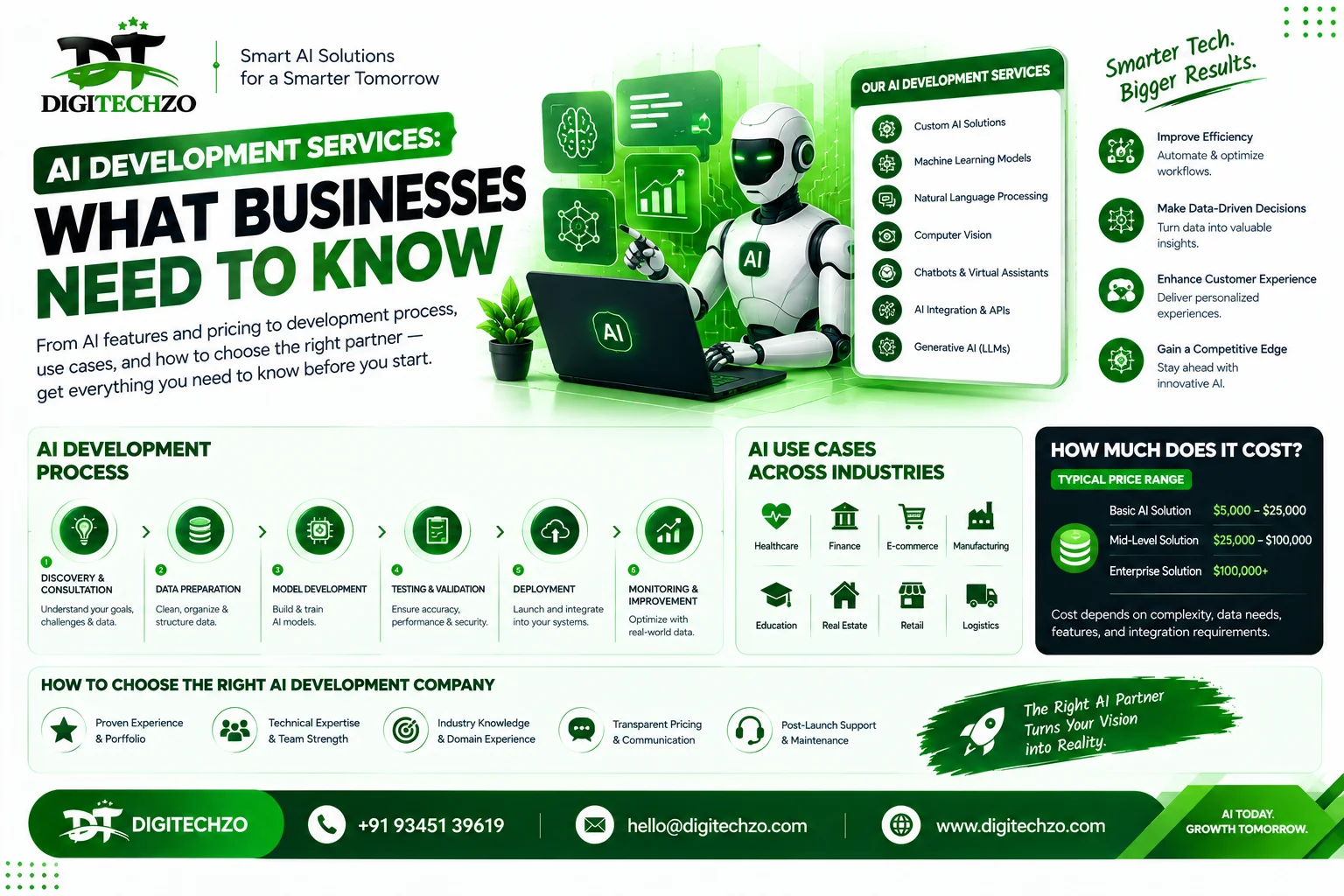
AI development services encompass the design, build, deployment, and ongoing maintenance of custom artificial intelligence systems - including machine learning models, natural language processing tools, computer vision applications, and generative AI integrations - tailored to a specific business problem. Unlike off-the-shelf AI tools, these services involve data engineering, model training or fine-tuning, system integration, and continuous monitoring, typically costing anywhere from $15,000 for a focused pilot to $500,000+ for enterprise-grade platforms, depending on scope and data complexity.
What Are AI Development Services, Exactly?
AI development services refer to the specialized work of designing, building, training, and deploying artificial intelligence systems that solve a defined business problem - as opposed to buying a generic SaaS tool and hoping it fits.
This typically includes:
- Data strategy and engineering - collecting, cleaning, labeling, and structuring the data a model needs to learn from
- Model development - building, training, or fine-tuning machine learning and deep learning models
- Integration engineering - connecting the AI system to your existing software (CRM, ERP, mobile apps, internal tools)
- MLOps and deployment - putting models into production reliably, with monitoring and retraining pipelines
- Ongoing optimization - retraining models as data drifts and business needs evolve
The key distinction: AI development services build something specific to your data, your workflows, and your customers - not a one-size-fits-all product.
Why This Matters Right Now
According to McKinsey's State of AI research, a majority of organizations report using generative AI in at least one business function, yet most also report struggling to scale pilots into measurable ROI. That gap - between experimentation and production value - is precisely where professional AI development services earn their keep. The technology to build a demo is now widely accessible; the expertise to build something reliable, secure, and cost-effective at scale is not.
Types of AI Development Services
Not all AI projects are the same, and understanding the category you need helps you evaluate vendors more accurately.
Machine Learning Model Development
Custom models trained on your historical data to predict outcomes - churn prediction, demand forecasting, fraud detection, credit risk scoring. These require structured data and domain-specific feature engineering.
Natural Language Processing (NLP) Solutions
Systems that understand and generate human language: document summarization, sentiment analysis, intelligent search, ticket routing, and contract analysis.
Generative AI and LLM Integration
This is the fastest-growing category in 2026. It includes:
- Custom chatbots and virtual assistants built on large language models
- Retrieval-Augmented Generation (RAG) systems that ground AI answers in your company's actual documents
- AI copilots embedded inside existing software
- Fine-tuned or prompt-engineered models for specialized tasks (legal drafting, medical coding, code generation)
Computer Vision Applications
Systems that interpret images or video - quality control on a manufacturing line, inventory counting via camera feeds, medical imaging analysis, or automated document/ID verification.
Predictive Analytics and Recommendation Engines
Used heavily in retail, media, and finance to personalize experiences: product recommendations, dynamic pricing, next-best-action engines.
AI Agent Development
An emerging category: autonomous or semi-autonomous agents that can execute multi-step tasks - booking, research, data entry, customer support resolution - with minimal human intervention, often orchestrating multiple tools and APIs.
AI Development vs. Traditional Software Development
Businesses new to AI often assume it's "just another software project." It isn't. Here's where the two diverge:
| Factor | Traditional Software | AI Development |
|---|---|---|
| Core input | Requirements and logic rules | Data quality and quantity |
| Predictability | Deterministic - same input, same output | Probabilistic - outputs can vary and require monitoring |
| Testing | Functional test cases | Model validation, bias testing, drift monitoring |
| Timeline risk | Scope creep | Data readiness and model performance uncertainty |
| Post-launch work | Bug fixes, feature updates | Continuous retraining, performance monitoring, data pipeline maintenance |
This distinction matters because it changes how you should budget, plan, and set expectations. A traditional software vendor can usually give you a fixed-scope quote upfront. A credible AI development partner will often recommend a discovery or pilot phase first - because nobody can honestly promise model accuracy before seeing your data.
The AI Development Process, Step by Step
A well-run AI engagement typically follows this sequence:
1. Discovery and Feasibility Assessment
Before any code is written, the right question isn't "what can AI do?" - it's "what business outcome are we trying to move, and is AI actually the right tool for it?" This phase audits your existing data, defines success metrics, and often exposes whether the real bottleneck is data quality rather than model sophistication.
2. Data Audit and Preparation
This is the step most vendors underestimate - and the one that determines whether the entire project succeeds. It involves auditing data sources, closing gaps, removing duplicates, handling missing values, and setting up pipelines for ongoing data flow.
3. Prototype / Proof of Concept
A scoped-down version of the solution, built to validate feasibility against real data before committing to full development. This is where you should demand measurable benchmarks, not just a polished demo.
4. Full-Scale Model Development and Training
Building out the production model, running structured evaluation against test data, and iterating on accuracy, latency, and bias.
5. Integration and Deployment
Connecting the model to production systems via APIs, setting up infrastructure (cloud or on-prem), and establishing security and access controls.
6. Monitoring, Retraining, and Optimization
AI models degrade over time as real-world data shifts - a phenomenon called model drift. Ongoing monitoring and periodic retraining are not optional extras; they're what keeps an AI system useful six months after launch.
How Much Do AI Development Services Cost?
Pricing varies enormously based on scope, but here's a realistic breakdown based on typical project categories:
- Chatbot / AI assistant (RAG-based, using existing LLMs): $15,000-$60,000
- Custom predictive analytics model: $30,000-$120,000
- Computer vision application: $40,000-$150,000
- Enterprise-grade custom ML platform: $150,000-$500,000+
- AI agent / multi-step automation system: $50,000-$200,000
Factors That Move the Price
- Data readiness - clean, structured, labeled data is cheaper to work with than messy or siloed data
- Model complexity - using an existing foundation model (like GPT or Claude) via API is far cheaper than training a model from scratch
- Integration depth - connecting to five legacy systems costs more than connecting to one modern API
- Compliance requirements - healthcare (HIPAA), finance (SOC 2, PCI-DSS), or EU operations (GDPR) all add engineering and audit overhead
- Ongoing MLOps - budget 15-20% of initial build cost annually for monitoring, retraining, and infrastructure
Build In-House vs. Outsource: Pros and Cons
Building an In-House AI Team
Pros:
- Full control over roadmap and IP
- Deep, accumulated institutional knowledge
- No vendor dependency long-term
Cons:
- AI/ML engineering talent is expensive and scarce - senior ML engineers often command premium salaries
- Slow time-to-hire (often 3-6 months per role)
- Risk of building a team before validating the use case
Outsourcing to an AI Development Company
Pros:
- Faster time to market - an experienced team has already solved similar problems
- Access to a broader skill set (data engineers, ML engineers, MLOps, prompt engineers) without five separate hires
- Lower upfront risk - you can pilot before committing to a full build
Cons:
- Requires careful vendor vetting
- Knowledge transfer needs to be managed deliberately
- Ongoing costs if you don't negotiate IP and handover terms clearly
Our take: Most businesses get the best of both - outsourcing the initial build and specialized model work to an experienced AI development partner, while training internal staff to own day-to-day monitoring and business logic updates. This hybrid model is exactly how we structure engagements at Digitechzo, so clients aren't permanently locked into an external vendor for basic maintenance.
How to Choose an AI Development Company
Ask these questions before signing anything:
- Can you show a production system, not just a demo? Anyone can build an impressive demo in a weekend. Ask for a case study with measurable business impact.
- What's your data security and compliance process? If they can't clearly explain how your data is stored, encrypted, and who has access, that's a red flag.
- Do you build on proprietary or open frameworks? Vendor lock-in on proprietary models can be expensive to reverse later.
- What happens after deployment? If a vendor's pitch stops at "launch," ask who owns monitoring and retraining.
- Can you explain why a model made a decision? Explainability matters, especially in regulated industries.
- What's your team's actual composition? A real AI team includes data engineers, ML engineers, and domain experts - not just generalist developers using an API wrapper.
Common Mistakes Businesses Make
- Starting with the technology instead of the problem. Chasing "we should use AI for something" instead of identifying a specific, measurable bottleneck.
- Underestimating data readiness. Most AI project delays trace back to messy, siloed, or insufficient data - not model performance.
- Skipping the pilot phase. Jumping straight to full-scale build without validating feasibility on real data first.
- Treating AI as a one-time project. Models degrade without monitoring and retraining; budgeting stops after "launch" and performance quietly declines.
- Ignoring change management. Even a technically perfect AI tool fails if the team using it doesn't trust or adopt it.
- Choosing the cheapest vendor. Low upfront cost often means a wrapper around a public API with no real customization, data strategy, or long-term support.
- No clear success metric. "Make us more efficient" isn't measurable. Projects need a defined KPI before development starts.
Expert Tips for a Successful AI Project
- Start narrow, prove value, then expand. A focused pilot that demonstrably saves 10 hours a week per team is more valuable - and more fundable internally - than an ambitious platform that takes a year to see results.
- Insist on a data audit before quoting a full build. Any vendor willing to give you a fixed-price, fixed-scope quote for a complex AI system without first reviewing your data should be scrutinized.
- Budget for maintenance from day one. Treat the first year's total cost of ownership as build cost plus 15-20% for monitoring and retraining, not build cost alone.
- Define your "good enough" accuracy threshold upfront. Perfect accuracy is rarely necessary or achievable; know what performance level actually moves the business metric you care about.
- Keep a human in the loop for high-stakes decisions. Especially in finance, healthcare, and hiring, use AI to augment decisions, not fully automate them, until trust and track record are established.
- Document everything for compliance, even if you're not regulated yet. Regulatory frameworks around AI (EU AI Act, sector-specific U.S. guidance) are expanding quickly; good documentation now saves painful retrofits later.
Why Businesses Choose DigiTechzo AI Development Company
DigiTechzo approaches AI projects with an emphasis on practical business requirements and relevant technologies, including machine learning, natural language processing, computer vision, and generative AI integrations. This makes the development process more aligned with the technical and operational challenges businesses face when implementing AI.
For organizations evaluating their options and looking for a team capable of developing customized AI solutions, exploring DigiTechzo as an AI Development Company can provide a clearer understanding of its approach, capabilities, and AI development expertise.
FAQs
What industries benefit most from AI development services?
Finance, healthcare, retail, logistics, and manufacturing see the fastest ROI because they generate large volumes of structured data and have clear, measurable processes - fraud detection, inventory forecasting, and diagnostic support are common high-impact use cases.
How long does a typical AI development project take?
A focused pilot or proof of concept usually takes 4-8 weeks. A full production-grade system typically takes 3-6 months, depending on data readiness, integration complexity, and compliance requirements.
Do I need my own data scientists to work with an AI development company?
No. A full-service AI development partner provides data engineers and ML engineers as part of the engagement. However, having someone internally who understands your business data and processes speeds up the discovery phase significantly.
What's the difference between using ChatGPT/Claude directly and hiring AI development services?
Using a general AI assistant directly works for individual tasks. AI development services build a system around a model - integrating it with your data, business logic, security requirements, and existing software - so it works reliably for your specific workflow, not just a single conversation.
Is generative AI development more affordable than traditional custom ML?
Often, yes. Building on top of existing large language models via API (rather than training a model from scratch) significantly lowers cost and development time, which is why RAG-based chatbots and AI copilots are typically the fastest, most affordable entry point into custom AI.